|

In
Canada, it's party time. Prime Minister Mark Carney's
Government has decided to make the tax incentive to
support Employee Ownership Trusts permanent. This means
that, once and for all, the number of transfers of businesses
to employees will increase in Canada, just as it has
done in the USA and, since 2014, in the UK.
The trust model makes this possible. The trust embodies
ownership by the company's community of employees. It
is this collective that becomes the owner of the company,
without the employees having to put a penny of their
own money into it. It's a credit sale. Generally, it
is the seller of the company that extends credit to
the employee trust, known as a "vendor loan”. The
seller of the business agrees to spread the payment
of the sale over a period of time, generally five to
seven years. The trust being the owner, it can use the
company's profits to repay the loan to the seller.
Why does the seller agree to this payment period? Because
the tax incentive exempts the seller from tax on the
sale of the company to the employee trust. And so we've
come full circle. In the final analysis, the company's
employees are the main beneficiaries of the tax-free
sales proceeds granted to the vendor.
In the United Kingdom it's no longer a party.
For nearly six months now, the situation has been confused.
The government of Chancellor of the Exchequer Rachel
Reeves has decided to retax the sale of companies to
employees. Instead of 100% tax relief on the proceeds
of the sale, this is now only 50%, or half.
As a result, the credit mechanism for staggering payment
has become much more complicated, or even impossible.
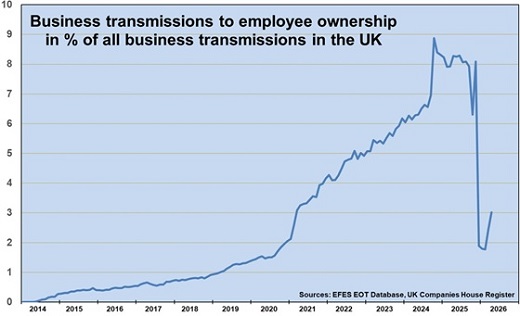
Many owners have decided not to sell to employees. Overnight,
the number of businesses transferred to employees plummeted.
Recent findings show that we are moving towards a new
equilibrium: Instead of 100 companies being passed on
to employees before Ms Reeves' decision, there will
now only be 50, i.e. half that number or even slightly
lower. Instead of 8% of all business transfers going
to employees before Ms Reeves' move, only 3 or 4% will
do so in future (see graph).
Ms Reeves' motives remain obscure in this mess, a mixture
of ideological whims and vested interests - nothing
solid. And the consequences are manifold, as we'll come
back to shortly. What is certain is that employees are
ultimately the main losers of the re-taxation sought
by Ms Reeves' government.
There is only one way to avert this British disaster. It
is essential to reinstate the 100% exemption on capital
gains relating to the sale of a company to an Employee
Ownership Trust.
The latest news is that Canada could be preparing to
send a new ambassador to United Kingdom.
More
info
|